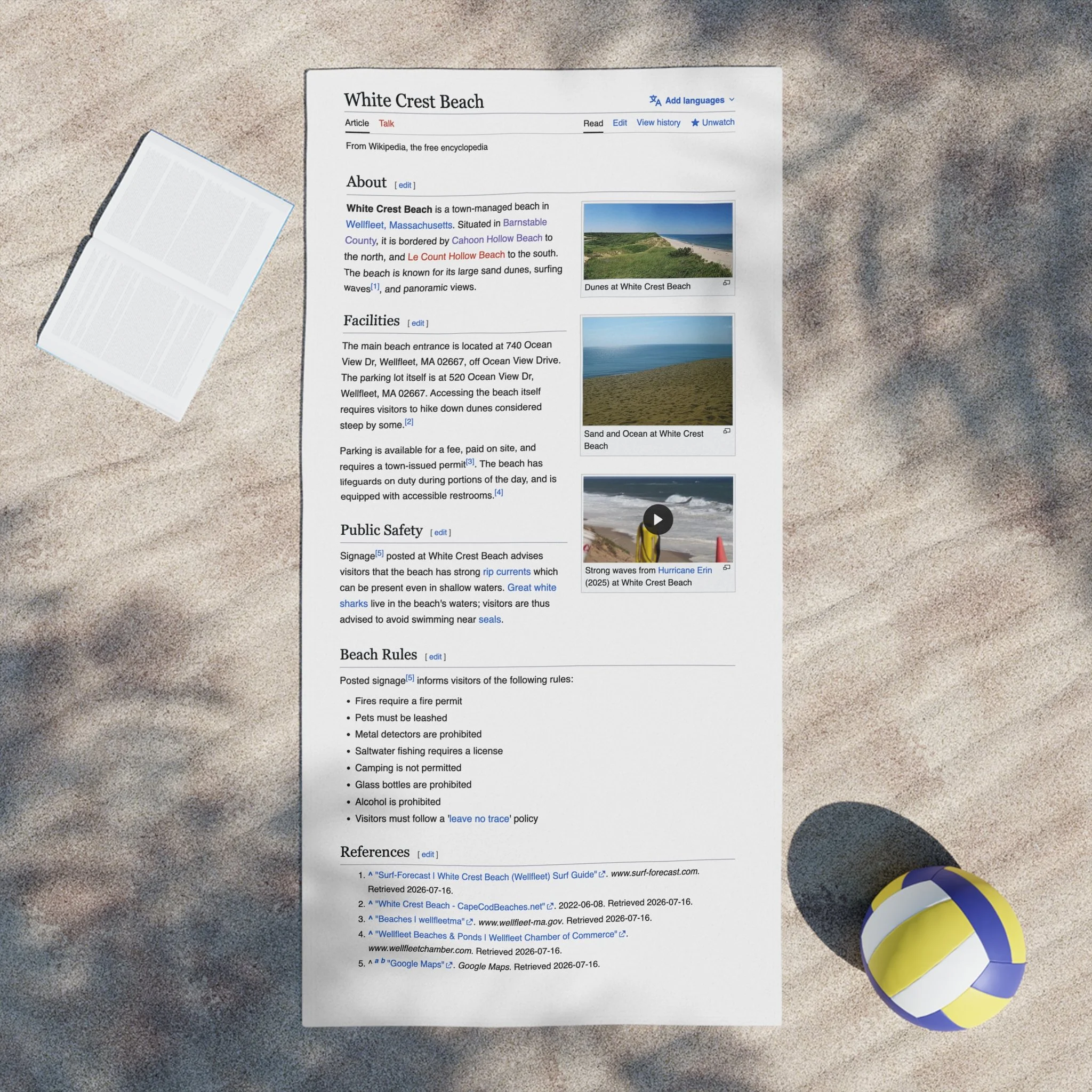
Free as in Beach, 2026
Wikipedia page, beach towel
Around the start of July, my old friend Brian Butler invited me to take part in his Beach Towel Art Show, to be held in Wellfleet, MA on August 23, 2026. I believe it’s the second one in Wellfleet and builds off similar work Brian’s done in Miami. I was told it’s a very DIY affair with few rules. I’ve spent a lot of time in Wellfleet at Newcomb Hollow, Indian Neck, and Mayo Beach — but never White Crest, where this event’s set to take place. I thought I’d look it up, only to learn the beach was not yet on Wikipedia.
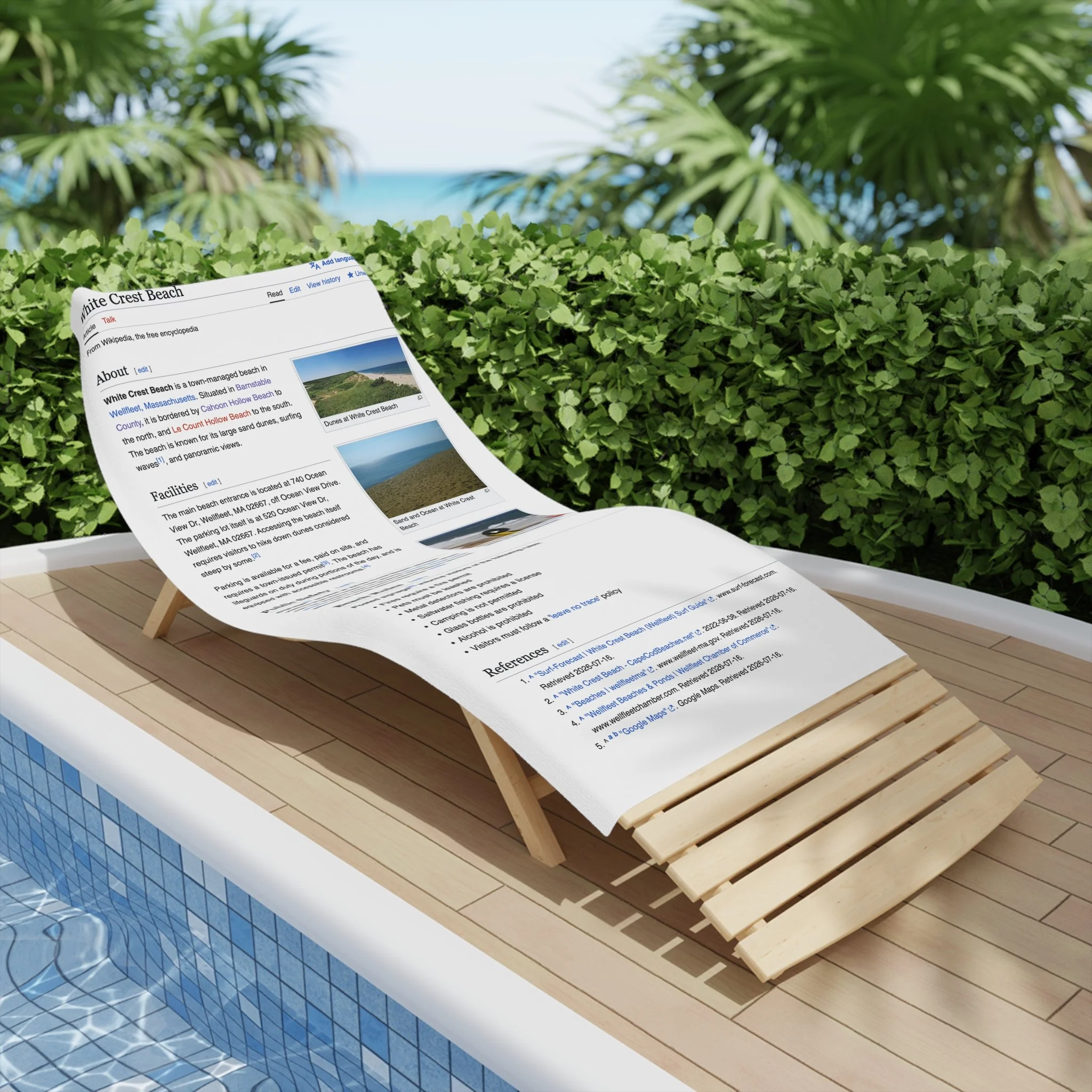
In response, I compiled some basic info on location, geography, access, rules. and warnings and got a new entry up. This was only my second ever Wiki entry started, the other was for the Museum of Sorcery and Witchcraft in Iceland. The last step, of course, was to use a print-on-demand service to produce a towel with the entry on it. The mockups seen here come from said printing service.
The title, Free as in Beach, is a play on Richard Stallman’s old phrase “Free as in speech, not free as in beer” used to describe the core ideas behind the free software movement. While Stallman has appropriately been taken down a peg for a bunch of shitty things said and done, this phrase is bigger than him. For me it applies to beaches in that I don’t mind entry fees that help support the beach’s upkeep, but I take some issue with beach policies limiting my freedom to practice metal detecting.
Metal detecting is a wholesome, educational activity, and should be considered alongside fishing and fire-building as a permitted activity.
Detecting certainly does less harm to the environment than fishing or fire-building
Detecting could be limited to certain times as to avoid disrupting others’ experience of beaches
Recognizing the fragility of the dunes as an ecosystem, and the need to protect nesting sites, let us consider that a child burying a parent in sand is far more disruptive than a 4” target dig, especially if one is using a pinpointer
Detectorists are generally finding tent stakes, bottle caps, old bits of wire, and other debris that doesn’t belong in the ground or sand. We take the trash out with us, improving the environment and safety for the shoeless
Many detectorists would contribute findings to local museums, pop-ups, or other tourism-driving events
Revenues from permitting fees help municipalities protect natural resources